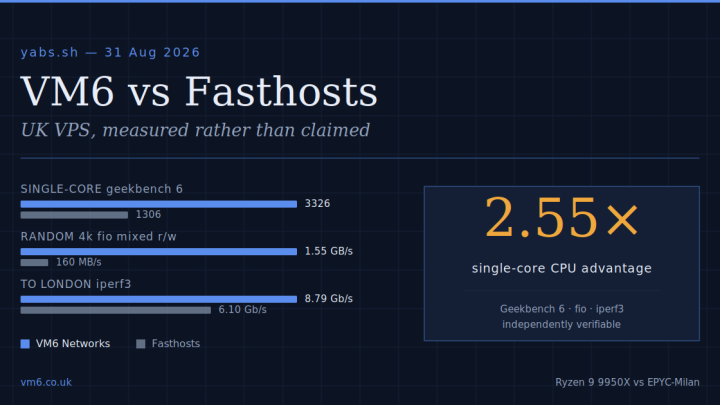
If you’re a UK developer running a high-traffic web app, a latency-sensitive game server, or a SaaS platform that needs to feel snappy, you’ve probably noticed something: not all VPSes are built the same. The difference often comes down to the processor under the hood. That’s where AMD Ryzen — specifically the Ryzen 9950X — changes the game, and why more UK devs are ditching older Intel Xeon or generic cloud instances for something with real single-threaded punch.
What Makes Ryzen 9950X Different for Web Apps?
Web applications — especially those built with frameworks like Laravel, Node.js, or Go — are heavily dependent on single-thread performance. A CPU that can churn through requests faster means lower Time to First Byte (TTFB), faster database queries, and happier users. The Ryzen 9950X, based on AMD’s Zen 5 architecture, delivers some of the highest single-thread scores we’ve seen in a consumer-grade chip. For a VPS host, that translates directly into performance you can feel.
We covered the raw specs of the 9950X in our Major Infrastructure Upgrade post, but here’s the real-world takeaway: with 16 cores and 32 threads, plus boost clocks north of 5.7 GHz, this chip doesn’t just benchmark well — it handles concurrent connections and compute-heavy tasks without breaking a sweat. For a UK-hosted app, that means less queuing at the CPU level and faster responses for your users.
Low Latency Matters — Especially for UK Users
Say you’re running a REST API for a fintech app used by small businesses in London. Every millisecond of latency adds up. With a UK-based AMD Ryzen VPS, you’re not just getting fast compute — you’re getting it close to your audience. Our infrastructure sits in UK data centres, so the round-trip time from a user in Manchester or Birmingham is often under 10 ms. Pair that with NVMe storage and a 10 Gbps network, and you’ve got a setup that handles spikes without drama.
For context, we previously rolled out our Ryzen 7900 VPS range, which was already a step up. The 9950X version pushes single-thread performance even further — ideal for apps that can’t afford to wait.
Real-World Scenario: Game Servers
Think about a Rust or Minecraft server for 60 players. Those games are notoriously single-thread hungry. On a budget VPS with a generic CPU, you’ll hit lag when players spread out or build complex structures. Move that to a Ryzen 9950X VPS, and the server can tick faster, keeping everyone in sync. UK gamers get the bonus of low ping because the server’s in-country. It’s not magic — it’s just better hardware in the right place.
Transparent Pricing and No Surprises
One thing that frustrates developers is variable pricing. You spin up a cloud instance, get a bill that jumps because of burstable CPU or egress costs. We keep it simple: what you see is what you pay. Our Ryzen 9950X VPS plans come with dedicated CPU cores, NVMe storage, and unmetered bandwidth at a fixed price. No hidden fees, no “CPU credits” nonsense. For a startup or a solo dev, that predictability matters.
Key Benefits at a Glance
- Single-thread performance — Ryzen 9950X leads the pack for web apps and game servers.
- Low latency — UK data centres mean fast response times for local users.
- NVMe storage — Gen4 NVMe drives for quick database lookups and file serving.
- 10 Gbps network — Handles traffic spikes without bottlenecking.
- Transparent pricing — Fixed monthly cost, no egress charges or burstable limits.
Should You Make the Switch?
If your current host uses older Intel Xeons or shared resources, you’re leaving performance on the table. For UK developers running high-performance web apps — whether it’s a SaaS platform, a real-time API, or a multiplayer game — a Ryzen-based VPS offers a noticeable improvement. We’ve seen it in our own benchmarks and in customer feedback: faster page loads, better concurrency, and fewer support tickets about slowdowns.
We’re not saying you need a dedicated server for everything. But if you’re pushing a modern web app, a budget-friendly Ryzen 9950X VPS might be the upgrade that makes your users stop complaining and start staying. Try it for a month; the difference is obvious.