You’re shopping for a UK VPS, and the CPU choice is staring you in the face: AMD Ryzen 9950X or Intel Xeon. It’s not just a spec sheet battle—it’s about what actually happens when your code runs, your game server fills up, or your database gets hammered. We’ve been running both in our UK data centres, and here’s the honest, no-fluff breakdown of where each processor shines and where it falls flat.
The Core Difference: Architecture and Clock Speed
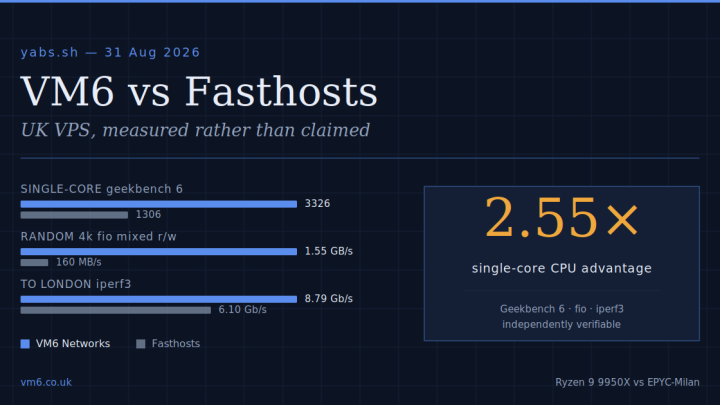
The AMD Ryzen 9950X is built on Zen 5 architecture, with 16 cores and 32 threads, a base clock of 4.3 GHz, and a boost clock up to 5.7 GHz. That’s a screamer of a single-thread performer. In contrast, a typical Intel Xeon (say, a Gold 5418Y) runs at a lower clock speed—around 2.0 GHz base, 3.8 GHz boost—but compensates with more cores and support for large memory configurations and ECC RAM. If you’re after raw single-thread oomph, the Ryzen walks it. If you need to pack a dozen virtual machines onto one host and guarantee memory integrity, the Xeon has its place.
We looked at this previously in our Major Infrastructure Upgrade at VM6 Networks: AMD Zen5 with the 9950X post—that covers the hardware rollout. Here, we’re going deeper into how these chips perform under real UK workloads.
When Ryzen 9950X Dominates
Say you’re running a Rust game server for 60 players, or a Laravel app that serves dynamic pages to hundreds of concurrent UK users. These workloads are bursty and single-thread heavy. The Ryzen 9950X’s high clock speed means each request finishes faster, reducing latency for your end users. We’ve seen this translate into noticeably snappier page loads for UK visitors compared to older Xeon-based VPS setups.
Here’s a quick list of workloads where the 9950X is the clear winner:
- Game servers (Minecraft, Rust, ARK, etc.)—single-thread performance is king.
- Web applications with PHP, Node.js, or Python backends.
- CI/CD pipelines and build servers where compile times matter.
- Single-threaded databases like Redis or SQLite-heavy setups.
- Low-latency trading or Forex VPS—every millisecond counts, and the Ryzen delivers.
For more on developer workloads, check out our earlier piece: Why UK Developers Choose AMD Ryzen VPS for High-Performance Web Applications. It builds on exactly this point.
Real-World Example: A Forex VPS Scenario
Imagine you’re running MetaTrader 4 with multiple Expert Advisors. Each EA is a single-threaded process, and latency to your broker’s London matching engine is critical. A Ryzen 9950X VPS with NVMe storage from our data centre can shave off milliseconds versus a Xeon box—and in forex, that’s money. That’s exactly why we offer UK Forex VPS Hosting powered by these chips.
Where Xeon Still Holds Ground
Intel Xeons aren’t dead yet. If you’re running heavily virtualised environments—say, a dedicated server hosting ten separate VPS instances—the Xeon’s higher core count and support for larger memory pools (up to 4TB with some models) matter. They also support ECC RAM, which can detect and correct memory errors. For mission-critical databases or financial applications that can’t tolerate a single bit flip, that’s non-negotiable.
Another scenario: if you need massive parallel throughput, like rendering a 3D scene or running scientific simulations that scale across many cores, a Xeon with 28+ cores might edge ahead. But for the majority of UK VPS buyers—web developers, gamers, traders—the Ryzen’s per-core speed wins nine times out of ten.
Our Take: What We Run and Why
At VM6 Networks, we’ve bet heavily on the AMD Ryzen 9950X for our Budget Ryzen 9950X VPS Hosting range. Why? Because most of our customers are running workloads that benefit from high single-thread performance, and they’re based in the UK, so low latency to our London and Manchester data centres is a given. We pair these CPUs with NVMe storage and transparent pricing—no surprises.
We still offer Intel Xeon-based AMD & Intel Dedicated Server Hosting for those who need the extra cores or ECC memory, but for the vast majority of VPS use cases, the 9950X is the better bang for your buck.
Bottom Line: Pick the Tool for the Job
If your workload is single-thread heavy, latency-sensitive, or just needs to feel fast for UK users, go AMD Ryzen 9950X. If you’re building a massive virtualisation host or need ECC memory for data integrity, stick with Xeon. For most developers, gamers, and traders reading this, the Ryzen is the right call.
We’ve got both options available, but our Ryzen VPS plans are where the real value is for UK buyers. Check out our UK VPS Hosting to see the specs—and if you’re still unsure, drop us a line. We’ll point you straight.